‘I take risks every day … what doesn’t kill a man makes him stronger’ – Tayo Adiatu
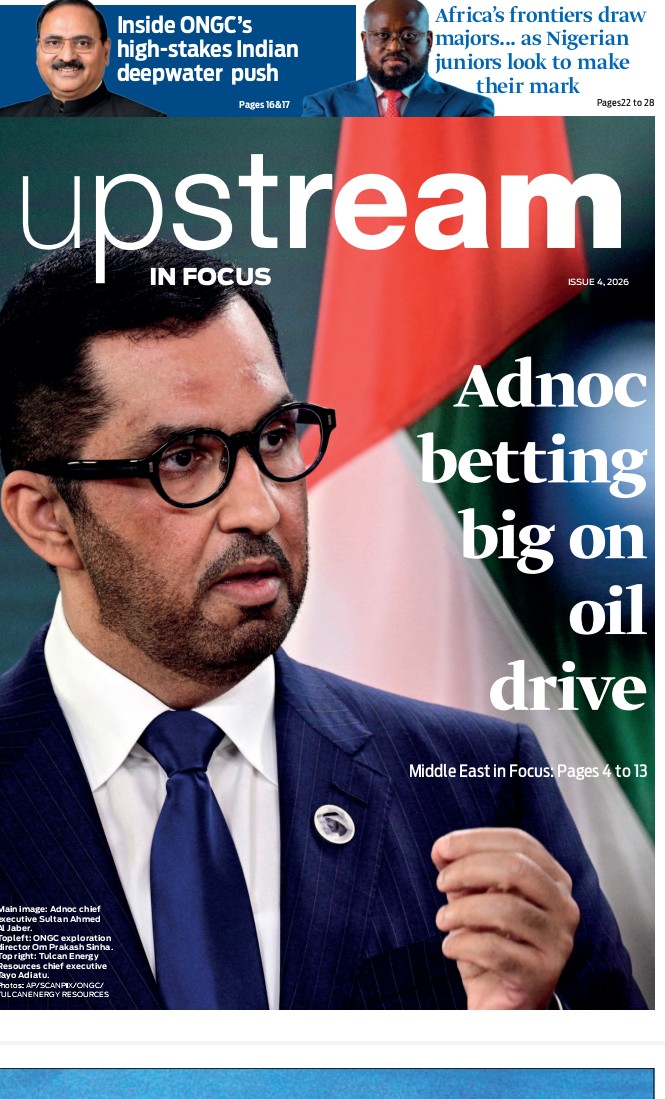
Prince (Dr) Tayo Adeyemi Adiatu is Chief Executive of Tulcan Energy Resources, Lagos. In this interview with Upstream in Focus (Issue 4 2026), he dwells on the recent strides of his company towards breaking new frontiers in the oil and gas industry. It reeks of his ambition to strike deeper, and during the encounter, he unveils one of the principles making him unstoppable – risk taking. He notes that when one survives it, strength comes naturally.
Though an Iwo Osun state Prince, of an illustrious father, Prince G.A. Adiatu (whose exploits as a clinic founder, gave a section of Ogbomoso its name – “Adiatu Area” – at Odo-Oru), he is a pride of Ogbomoso, born and bred in her streets. On a personal note, he has made several and incredible interventions in the city including at his alma maters – Anglican Grammar School and LAUTECH.
ogbomosoinsightonline.com reproduces the text of the interview with Upstream magazine, verbatim, in this article originally titled, “Ambitious Adiatu eyes deep.”
Advertisement
Advertisement

Advertisement

Advertisement
Enjoy …
In the first of two interviews exploring how smaller domestic producers are flourishing in Nigeria, Upstream hears how one independent is prepared to go it alone in deepwater exploration.
“Look at these eyes,” states a smiling Tayo Adiatu, chief executive of Lagos-based Tulcan Energy Resources, as he removes his glasses. “They are not risk averse.”
Adiatu is responding to Upstream’s query on why the Lagos-headquartered junior player would consider self-funding a costly deepwater exploration drilling campaign on a block in the Niger Delta basin.
The block in question is Petroleum Prospecting License (PPL) 2008, which Tulcan secured for five years after successfully bidding for the asset in a 2024 licensing round.
“I take risks every day … I’m an entrepreneur who believes that what doesn’t kill a man makes him stronger,” the Nigerian businessman tells Upstream although he stresses that E&P decisions are underpinned by solid data and advice, and are not taken “aggressively.”
Typically, in deepwater exploration acreage, small companies will finance the cost of data gathering themselves before trying to entice a well-funded and technically capable major to take on the drilling via a farm-out.
But Adiatu is open to Tulcan funding its own drilling campaign in PPL 2008, which lies in 1200 to 1800 metres of water, if it generates value more effectively and efficiently.
Tulcan is among a number of independent Nigerian developers today exploiting upstream assets that were once the preserve of larger international oil firms or too small for them to exploit effectively.
Boosted by 2007’s National Petroleum Policy and the Petroleum Industry Act of 2021, which sought to improve the sector’s business environment among other objectives, Nigeria’s E&P industry has further warmed to current President Bola Tinubu’s policy initiatives and executive orders which have created an attractive, streamlined and much more transparent investment environment.
While a relative newcomer to Nigeria’s upstream arena, Tulcan is no stranger to the country’s oil and gas sector.
Since its founding in 2011, the company has been heavily involved in downstream activities.
But Adiatu says it was always his goal to take Tulcan upstream: “We were only waiting for the right opportunity.”
After bidding in a marginal licensing round in 2020 and establishing its E&P business in 2021, Tulcan was awarded the shallow-water Tom Shot Bank (TSB) field in Akwa Ibom state in 2022.
The following year it landed control of the Odimodi gas-condensate field in a coastal swamp play in Delta state.
Tulcan is no fly-by-night upstream player. It has a 60-strong team of professionals boasting subsurface, drilling, production, production, supply-chain, commercial, financial and health, safety and environment (HSE) skills, developed over years at companies including Shell, Seplat, Aramco, First E&P and Addax, among others.
To generate cash flow to pay off loans and to fund expansion plans, the team’s attention is trained on fully developing TSB, located near the mouth of Calabar River.
Like so many untapped fields in Nigeria, TSB was discovered by Shell. The supermajor’s initial probe in 1980 found oil and gas in seven reservoirs. An appraisal probe in 1989 hit four reservoirs and established that the field was faulted.
A 2011 drill stem test on the discovery well undertaken by Canadian minnow Mira Resources and Nigerian partner Equinox Oil & Gas flowed oil and gas.
Advertisement

Development plan
In 2024, the UK-based business of US technical and engineering consultancy Tetra Tech generated a three-phase development plan.
Funded by Tulcan, phase one involved drilling two wells, with oil sent via five-kilometre flowlines from simple wellhead structures to a swamp-based early production facility (EPF) for onward transport to market via barges.
While the two wells, TSB-3 and TSB-4, were drilled successfully, production was impossible because the export solution proved impractical.
Adiatu said barging was not possible due to the “very turbulent” waters in an estuary where the fresh waters of the Calabar and the smaller Akpa Yafe River meet salt water.

Also, mooring challenges in these waters meant Tulcan could not install a temporary storage vessel to receive the oil.
As a result, it was decided to retain the EPF but install a pipeline to take oil to a Universal Energy-operated production platform located 20-kilometres away, from where it is sent to Seplat’s Qua Ibo terminal.
Drilling of the two initial wells finished in December 2024 using a Shelf Drilling rig that was chartered to also include the drilling of TSB’s second-phase wells. However, due to a lack of cash flow, Tulcan sub-let the rig to other players until the third quarter of 2025, whereupon it got it back, completing the TSB-5 and TSB-6 wells in May this year.
While production from TSB-3 and TSB- is about 5000 barrels per day, TSB-6 are shut-in due to export constraints.
To tackle those constraints, Tulcan is investing in a 38-kilometre, 12-inch pipeline that will take oil direct to Qua Ibo, while replacing the EPF with a new 30, 000 bpd facility.
Advertisement

Nigerian contractor Bright-waters Energy has been appointed to install the 75, 000 bpd capacity pipeline. Tulcan hopes the installation will be completed by the end of 2026, with first oil set to flow in the first quarter of next year.
With the company targeting about 15, 000 bpd from TSB’s four wells by mid-2027, Tulcan will also be able to offer pipeline ullage to third parties, adding another cashflow stream.
TSB holds about 14 million barrels of oil in place. Proven and probable reserves initially stood at 10 million to 12 million barrels but this number is expected by Tulcan to hit 28 million to 30 million barrels.
Contingent resources lie on the other side of an in-field fault and could be assessed by drilling in mid-2027.
The field also hosts about 500 billion cubic feet of in-place gas resource. About 2 million cubic feet per day of gas is flared, a figure set to increase when TSB’s next two wells come on line. However, Tulcan plans to harness this resource via its own gas processing plant.
Advertisement

Adiatu views the new oil pipeline as a catalyst for the acquisition of other oil assets close to TSB, particularly as the 800, 000 bpd capacity Qua Ibo terminal is currently only handling some 300,000 bpd.
Tuican has invested “well over” $400 million into TSB, much from its own balance sheet, with $150 million loaned by financial institutions, supplemented by vendor financing and credit.
Big gas resource
Meanwhile, in what Adiatu says is a first for Nigeria, Tulcan has decided to carry out passive, seismic analysis on the Odimodi gas field – which has sizeable volumes of condensate and some oil – better understand the resource.
Uk contractor TenzorGeo is currently onsite acquiring data, with a final report expected at the turn of the year.
Tulcan hopes to start development drilling by the second quarter of 2027 and is talking with swamp rig owners about drilling two wells.
Advertisement

Adiatu says Odimodi could hold over 1 trillion cubic feet of in-place gas, enough to support production of 50 million to 60 million cubic feet per day, supplemented by up to 8000 bpd of condensate and oil.
First production could arrive by the fourth quarter of 2027. Gas and liquids could either be piped five kilometres to third-party facilities or Tulcan could build its own gas processing plant, a choice to be made when results are received from the first development well.
Advertisement

As for PPL 2008, which was awarded this July, Adiatu said it holds prospects similar to Shell’s nearby Bonga field.
Tulcan was also the successful bidder on PPL 3012 but decided to focus its efforts on PPL 2008 due to better prospectivity.
A commercial find in PPL 2008 could be tied back to nearby infrastructure or, if big enough, could be tapped by a floating production, storage and offloading vessel.
Adiatu says that a development stage, costing between some $2billion and $5 billion would involve “collaborating with the right international oil company – we’re not going to go crazy on a deep offshore asset”.
However, for the exploration phase, Tulcan wants to avoid being hamstrung by a slow-moving partner.
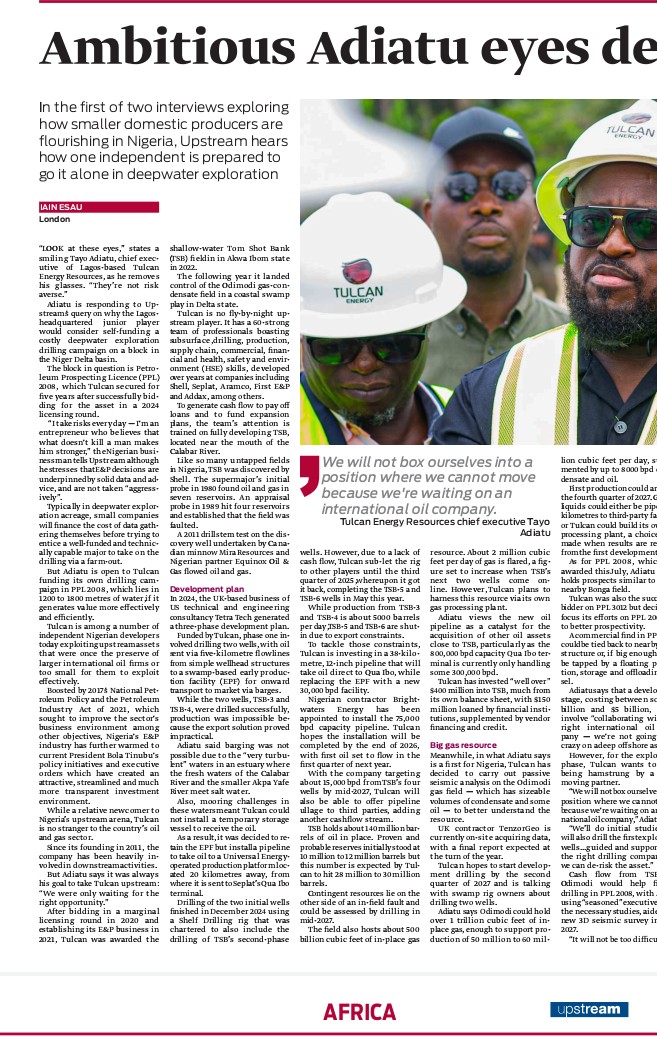
“We’ll not box ourselves into a position where we cannot move because we’re waiting on an international oil company,” Adiatu says.
Advertisement

“We’ll do initial studies. We will also drill the first exploration wells…guided and supported by the right drilling company… so we can de-risk the asset.”
Cash flow from TSB and Odimodi would help finance drilling in PPL 2008, with Adiatu using “seasoned” executives to do the necessary studies, aided a new 3D seismic survey in mid-2027.
“It will not be too difficult, or a big risk for us, to drill the first wells. We should not shy away from spending the initial $200 million to $500 million to de-risk [the block]. That is my opinion.”
Nevertheless, Adiatu acknowledges that the project is going to require much more than simply expertise.
Advertisement

“It’s going to require the right team, the right mindset, and the right finance. We’ll be very, very careful. If the superior argument is that we go for exploration with the right international oil company, we will do that.’
He predicts that, by the time PPL 2008 is ready to be drilled, Tulcan will be producing 30,000 to 40,000 bpd and generating robust cashflow, adding that an initial public offering (IPO) is on his agenda.
“At the right time, we’ll go the IPO way. Definitely we’ll look at a listing.”
Advertisement