
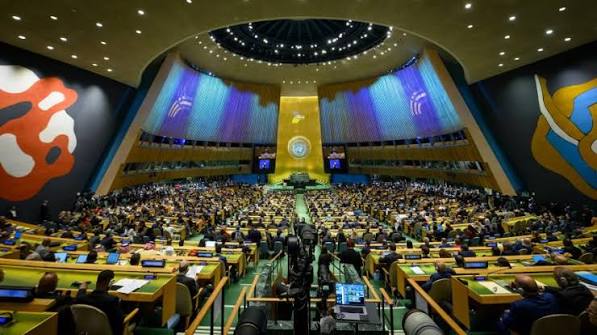
Between municipal and international jurisdiction: A word of caution to Gov Makinde
Toba ALABI
Advertisement

Advertisement

Introduction
On 14 July 2026, Governor Seyi Makinde of Oyo State publicly called on the United Nations and other international accountability mechanisms to investigate the abduction of schoolchildren and teachers in Oriire Local Government Area of Oyo State. The governor argued that the circumstances surrounding the kidnapping and the eventual rescue of the victims warranted independent international scrutiny. His statement immediately generated legal, political, and constitutional debates across Nigeria.
While the concern of every responsible government is to guarantee justice for victims and accountability for perpetrators, the governor’s request raises important questions about the jurisdiction of international organizations, the constitutional distribution of powers in Nigeria, and the doctrine of state sovereignty. Can the United Nations investigate an ordinary criminal offence committed within a sovereign state merely because a governor requests it? Does a state governor possess constitutional authority to invite international organizations to investigate criminal matters? What are the implications of such a request for Nigeria’s sovereignty and international image?
This paper argues that although Governor Makinde’s concern for justice is commendable, his appeal to the United Nations reflects a misunderstanding of the distinction between municipal jurisdiction and international jurisdiction. It also risks politicising a major security success that should unite rather than divide Nigerians.
Municipal Jurisdiction Under International Law
Municipal jurisdiction refers to the legal authority exercised by a sovereign state over persons, institutions, property, and criminal activities occurring within its territory. It includes the powers to investigate crimes, prosecute offenders, enforce judgments, and maintain public order.
Kidnapping is a criminal offence under Nigerian law. The investigation of kidnappings falls squarely within the responsibilities of Nigerian security agencies, including the Nigeria Police Force, the Department of State Services, the Armed Forces where necessary, and other relevant institutions established under the Constitution and federal statutes.
The kidnapping in Oriire Local Government was not committed outside Nigeria. It was not committed by another sovereign state. It did not occur in an international territory. Consequently, it remains a domestic criminal matter under Nigerian jurisdiction.
Advertisement

Advertisement

The Jurisdiction of the United Nations
The United Nations is not an international police organization. It was established primarily to maintain international peace and security, promote human rights, encourage international cooperation, and facilitate peaceful settlement of disputes between states.
The UN does not investigate ordinary crimes such as kidnapping, robbery, murder, or armed attacks occurring within member states unless those crimes form part of genocide, crimes against humanity, war crimes, or widespread systematic violations of international humanitarian law.
The Oriire school abduction, serious as it was, does not automatically fall within any of these categories.
There is therefore no legal basis upon which the United Nations can assume investigative jurisdiction over the incident merely because a state governor requested it.
Advertisement

Advertisement

Nigeria’s Constitutional Position
Nigeria operates a federal constitutional system.
Section 19 of the Constitution places the conduct of foreign policy squarely under the Federal Government. Matters relating to diplomacy, international organizations, treaties, and external relations belong to the Exclusive Legislative List.
No governor possesses constitutional authority to invite the United Nations to investigate criminal incidents on behalf of the Federal Republic of Nigeria.
Even where international assistance becomes necessary, such requests are made through the President, the Federal Ministry of Foreign Affairs, or other constitutionally recognised federal authorities.
Governor Makinde’s statement therefore has political value but no constitutional or legal force.
Advertisement

Advertisement

State Sovereignty and Non -Intervention
One of the cardinal principles of international law is sovereign equality.
Article 2(7) of the Charter of the United Nations clearly prohibits intervention in matters essentially within the domestic jurisdiction of member states except under exceptional circumstances authorised by the Security Council.
If every governor, provincial premier, or regional administrator around the world could independently invite the United Nations to investigate domestic criminal matters, the entire international legal order would descend into constitutional confusion.
International organizations cannot become substitutes for national criminal justice systems.
The Danger of Politicising Security Operations
The successful rescue of the abducted pupils and teachers should ordinarily be a moment of national celebration. Credit belongs first to the professionalism and sacrifice of Nigerian security agencies and to every institution that contributed to securing the victims’ freedom.
Unfortunately, Governor Makinde’s call for a United Nations investigation risks shifting public attention from the successful rescue operation to political controversy.
Security should never become an arena for partisan competition.
When elected leaders publicly question the credibility of national security institutions immediately after successful operations without presenting concrete evidence of misconduct, they may unintentionally undermine public confidence in those very institutions entrusted with protecting lives.
Constructive criticism remains an essential component of democratic governance. However, criticism should be evidence based, constitutionally grounded, and capable of strengthening rather than weakening national institutions.
Advertisement

Advertisement

A Word of Caution to Governor Seyi Makinde
Governor Seyi Makinde has earned national recognition as one of Nigeria’s influential governors. His commitment to education, infrastructure, and governance has attracted attention beyond Oyo State.
However, leadership also demands constitutional restraint and careful appreciation of institutional boundaries.
The call for a United Nations investigation into the Oriire school abduction appears legally unnecessary and constitutionally misplaced. More importantly, it risks politicising a sensitive security matter that ought to remain above partisan considerations.
The rescue of innocent schoolchildren should unite Nigerians rather than divide them along political lines. It should inspire confidence in ongoing efforts to combat kidnapping while encouraging further reforms where necessary.
If there are credible allegations of negligence, collusion, or operational failures, Nigeria possesses competent investigative institutions capable of examining such claims. Where additional expertise is required, the Federal Government retains the constitutional authority to seek international technical assistance through appropriate diplomatic channels.
Governor Makinde should therefore avoid introducing partisan interpretations into a matter involving the lives and security of innocent citizens. Public confidence in Nigeria’s security architecture is strengthened when political leaders support lawful institutional processes while demanding accountability through constitutional means.

Gov Makinde
Conclusion
The distinction between municipal jurisdiction and international jurisdiction remains fundamental to the international legal system.
The kidnapping in Oriire Local Government Area was undoubtedly a grave criminal offence deserving comprehensive investigation and prosecution. Nevertheless, it remains a municipal matter falling within Nigeria’s constitutional and legal jurisdiction.
Governor Seyi Makinde’s appeal to the United Nations, though perhaps motivated by a desire for transparency, lacks constitutional foundation and is inconsistent with established principles of international law governing state sovereignty and the jurisdiction of international organizations.
Nigeria’s security institutions should continue investigating every aspect of the incident. Those found culpable should face the full weight of the law. Equally important, political leaders should resist the temptation to politicise security operations or internationalise domestic criminal investigations without compelling legal justification.
The protection of Nigerian children is too important to become an instrument of political contestation.
Alabi is Professor of Political Science, Defence and Security Studies. 08036787582. tobalabi@yahoo.com















Leave a Reply