
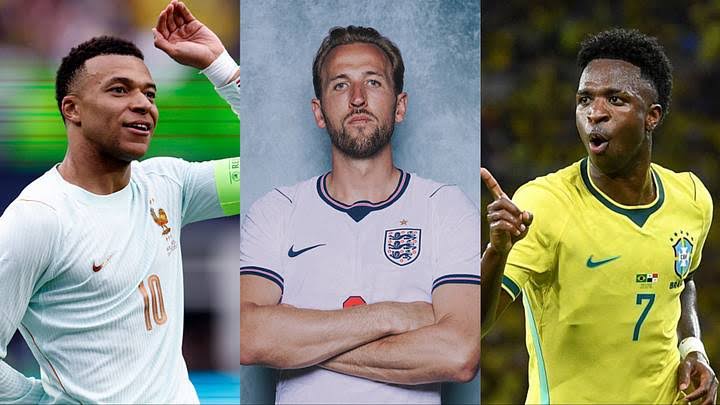
10 players to watch at the 2026 FIFA world cup
Yinka ADETUNJI
Advertisement

Advertisement

The world cup rarely follows a script. While teams win it, individuals usually shape it. From established superstars to rising talents, this edition brings a mix of pressure, expectation, and opportunity.
The player who already owns this stage — Kylian Mbappé
For Kylian Mbappé, the World Cup is not new territory. It is familiar ground. Even after a club season that did not peak individually, his reputation on this stage remains untouched. When the tournament arrives, Mbappé rarely needs rhythm to become decisive. He becomes the problem every defense is built to solve.
The teenage standard-bearer — Lamine Yamal
Lamine Yamal enters the tournament carrying something rare: expectation without hesitation. After a standout season in Spain, his influence has moved beyond potential into performance. The question now is not whether he can contribute, but whether he can define moments when Spain needs him most.
The finisher in his prime — Harry Kane
Harry Kane arrives after a record-breaking season in Germany, where goals came at a relentless pace. For England, he remains the reference point in attack, the player who turns sustained pressure into results. Tournament football often comes down to efficiency, and Kane offers very little waste.
Advertisement

Advertisement

The creator under pressure — Bruno Fernandes
Bruno Fernandes comes in after another heavy-output season, often carrying creative responsibility almost alone. With Portugal now boasting one of the strongest midfields on paper, his role becomes even more interesting. He is the player who can tilt a match with a single pass or decision.
The rhythm controller — Vitinha
Vitinha does not dominate headlines, but he dominates tempo. At club level, he has become one of the most reliable midfield anchors in Europe, dictating possession and stabilising matches. If Portugal control games at this tournament, it will be because he allowed them to.
The clutch factor — Jude Bellingham
Jude Bellingham arrives after a demanding season, but his reputation for decisive moments remains intact. Even when performances fluctuate, he has shown a tendency to appear when games are on the line. England will rely on that trait in tight knockout matches.
The reborn superstar — Ousmane Dembélé
Ousmane Dembélé comes into the world cup with a different level of expectation. After a season filled with success and individual recognition, he is no longer viewed as unpredictable talent alone. His pace and unpredictability still make him one of the hardest players to defend against when he is confident.
Advertisement

The game breaker — Jamal Musiala
Jamal Musiala remains Germany’s most direct source of attacking chaos. Despite injury interruptions, his ability to carry the ball through tight spaces and break defensive structure remains unmatched in their squad. Germany’s tournament hopes are closely tied to his fitness and form.
Brazil’s new centre of gravity — Vinícius Júnior
Vinícius Júnior enters as the focal point of Brazil’s attack. With Neymar no longer the central figure, responsibility naturally shifts toward him. His season tested him, but his ability to change games through pace and direct attacking play remains one of Brazil’s strongest weapons.
The breakout winger — Michael Olise
Michael Olise arrives at the tournament after a breakout season defined by creativity and consistent end product. His calmness in the final third and ability to decide games in tight moments make him one of the more unpredictable attacking threats in the competition.
Honourable Mentions
Some players sit just outside the main list, but their ability to influence games remains undeniable.
Erling Haaland remains one of the most feared goalscorers in world football. Even when Norway are not among the favourites, his presence alone guarantees attention from every defence they face.
Julián Álvarez continues to grow into a reliable big-game forward. His movement, pressing, and intelligence make him a constant threat in tournament football, even when he is not the main focal point.
Rayan Cherki offers something different. Creativity in tight spaces, unpredictable decision-making, and the ability to unlock stubborn defences could make him a surprise influence if given minutes.
João Neves represents the next wave of midfield control. Mature beyond his age, he brings composure and balance to a Portugal squad filled with attacking talent.
Lionel Messi remains football’s most influential presence in tournament history. Even in the later stages of his career, his ability to control the rhythm of a match and decide moments keeps him relevant whenever Argentina step onto the pitch.











Leave a Reply