
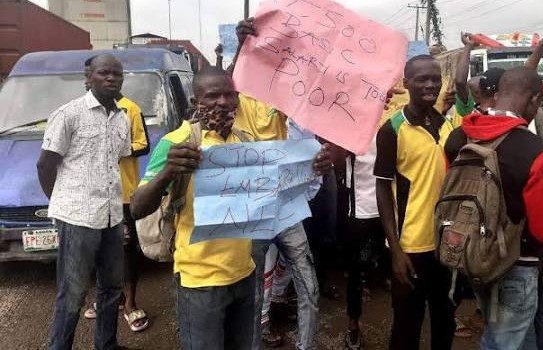
Image caption: Some casual workers protesting. Photo credit: Google
SPECIAL REPORT: How death of woman in LAUTECH highlights severe work condition of casual workers
This is syndicated special report by PIJAlance (an online magazine). The story is written by Enoch OYEDIBU
19-year-old Oluwaseyi Ajeigbe was not present when his mother collapsed in June 2025. Those who were there said the woman suddenly fainted while working as a cleaner inside the main campus of Ladoke Akintola University of Technology (LAUTECH), Ogbomoso, Oyo state. That moment marked the beginning of the end. Two months later, she never rose again. She died and was unceremoniously buried in August 2025.
Advertisement

Advertisement

But what really happened?
The deceased, Mrs. Sola Ajeigbe, was first reportedly treated and resuscitated at the LAUTECH Health Centre shortly after she fainted and defecated all over her body. She was later discharged and advised to rest the same day, according to eyewitnesses.
Multiple sources, including her son, Oluwaseyi, explained that she complained she was hungry and that there was no food at home, nor sufficient funds to care for herself and her two children. The late Mrs. Ajeigbe was also divorced.
As a member of the sanitation team at LAUTECH, her fellow cleaners, roughly 200 at the time, collectively contributed between ₦200 and ₦300 to purchase food items. Sources said the total contribution ranged between ₦20,000 and ₦30,000.
For one month, Mrs. Ajeigbe was granted what sources described as a voluntary leave, an uncommon concession for a worker of her status, with assurances that her salary would still be paid.
By the end of July, her condition deteriorated again. According to Oluwaseyi, who was close to her to the very last minute, this time, the illness became so severe that she could neither walk nor eat. But before that, she had already taken herself to a private hospital where she was admitted immediately.

Grave of Mrs. Ajeigbe
Oluwaseyi recalled her mother telling him the illness was “just an infection,” yet there were no funds to conduct the medical tests needed to properly diagnose the condition.
By the time her colleagues would contribute another round of ₦200 each to support her medical care, it was already too late and indeed the money was insufficient. One week later, Mrs. Ajeigbe died and was buried in a public cemetery in Ogbomoso North local government area of the state, leaving behind two children who are now living with relatives and many questions pointing back to LAUTECH and its labour force treatment.
Advertisement

Unfavourable condition
What happened to Mrs. Ajeigbe highlights the unfavourable condition of the casual workers at LAUTECH, who perpetually groan under the yoke of “underpayment.” A casual worker speaking under the condition of anonymity stated, “Yes we are grossly underpaid, our take home does not reflect the economic reality in the country, but we are stuck for lack of greener pasture.”
Casual workers are typically engaged on a flexible or irregular basis, often for short-term tasks without guaranteed continuity of work. Under Nigeria’s Labour Act, there is no specific statutory definition of casual employment. But, Section 7 of the Labour Act requires that any worker engaged for more than three months must be issued a written statement of the terms and conditions of employment.
In LAUTECH, the case is different. For more than three decades, cleaners (sweepers and gardeners) have been casualised, denied full employment, and poorly remunerated, in violation of all Nigerian laws and current minimum wages at both the Federal and State levels. These casual workers say that if they complain, they are sacked instantly and replaced, giving them no room for a fair hearing or labour treatment.
Mrs. Ajeigbe was part of them, and she was a sweeper. She often joined a pool of almost 200 others who clean the large expanse of the institution; buildings, lecture halls, and offices, from Monday to Friday for just ₦1,500 daily pay, totalling ₦30,000 monthly.
She was engaged in this for roughly 15 years, prior her death, in fact when she was first recruited, she reportedly earned ₦1,000 daily until 2023, when the payment was increased to ₦1,500 daily.
GIS image showing where the late Mrs Ajeigbe often travels from to LAUTECH every weekday.
She lived at Papa Alajiki area of the huge city and so daily travelled about 11. 44km (5.72km to and the same distance from). Sources close to her said she spent almost all of her ₦1,500 daily pay on transport. Oluwaseyi agreed, adding that they were constantly undernourished. “Either we eat once a day or nothing,” he informed. So, for Mrs Ajeigbe to conserve part of her ₦1,500 daily pay would trek a few kilometres, sometimes to Sabo, sometimes, before boarding commercial buses, this daily exertion took its toll on her health against the background of underfeeding.
Advertisement

The journey to be casual workers
One of the cleaners’ supervisors, identified as Oketola (not real name), who has spent 22 years working as a casual worker, told our correspondent that LAUTECH employed him, even though he was not provided with an employment letter. He said he was given a staff Identity Card, with a clear inscription: “Staff ID” on it.
“When I first joined them as a gardener, I was even given a staff Identity Card, duly signed by the Registrar of the school, that was in 2003. This confirms my employment,” Oketola said.
Oketola still keeps his staff ID, and PIJAlance Magazine has received a copy of it, along with multiple verifiable claims from other casual workers about similar employee ID cards.
Meanwhile, the Public Relations Officer of LAUTECH, Mr. Olalekan Fadeyi, denied issuance of any identity cards indicating they are fully employed staff of the institution, describing them as “unskilled workers.”
Beyond identity documentation, PIJAlance Magazine has established that salary payments for Mrs Ajeigbe and other casual workers were processed through LAUTECH’s payroll structure, confirming that wages were paid directly by the institution and not through any external contractor or third-party employer. This confirms casual workers’ employment as LAUTECH’s sole responsibility.

A cleaner busy at her duty
Though issuing staff IDs was eventually stopped sequel to a legal practitioner’s alleged advice to the institution. PIJAlance Magazine though could not independently confirm this.
Mr. Fadeyi insisted that by the principle of their recruitment, the casual workers have no binding document or staff Identity Card that shows they are full employees of LAUTECH. As such, he noted they could not receive the minimum wage as salaries.
“There is no rule guiding casual workers, except terms and conditions which they must have agreed with,” Mr Fadeyi said, adding that he could not blame the government for giving the casual workers the ₦30,000 monthly payment.
“I don’t know the agreement they signed. I have not seen their employment letter, so I cannot determine whether they are at fault. For example, if they want to promote me today, they will collect my letter of appointment, observe the conditions under which I accepted the employment, and my qualifications. Based on that, they will decide whether to promote me. But if these people (casual workers) have no letter of employment, no certificate, no staff identity cards… how can that suffice? I also have people there, but it is just unfortunate where they have found themselves. These are unskilled workers. I was not there when they were interviewing them, and to be sincere, I also have people with me,” the PRO said.
But PIJAlance Magazine has found contrasting evidence and claims against some of the PRO’s claims. A cleaner who begged to remain anonymous due to fear of reprisal stated that he graduated from the University of Ilorin with a B.Sc and also has an NCE certificate. He said others had a similar educational background, contrasting the claims of “unskilled workers.”
Advertisement

Working for working sake, paying loans, and collecting more till death do “us” part
Mrs. Ajeigbe was a trained chemist. She had secured a loan, the exact amount undisclosed because her son could not confirm it, from the LAUTECH Goodnews Cooperative Society, a members-owned association established to provide casual workers with access to credit, either in cash or essential food items, whenever the need arises.
For many casual workers at LAUTECH, membership of the Goodnews Cooperative Society offers a brief sense of relief. Working conditions feel manageable, almost relaxed, but only for a few months. That relief is short-lived.
Like all lending institutions, the society operates with clear terms and conditions. Once a loan is disbursed, repayment is enforced by directly linking the debt to the worker’s salary bank account. The society will deduct them monthly as the worker’s salary drops until they complete their payment.

Another casual worker in the institution
This deduction, however, is where the problem lies. Some casual workers are left with very little, or even nothing, to cover their immediate expenses after loan deductions.
For example, if a casual worker takes a loan of ₦200,000, of which ₦30,000 is his or her monthly salary, ₦20,500 is deducted by the society as monthly loan repayment. Such a worker who would walk away with just ₦9,500 after working for 20 days may choose how many months he would take to pay it, but the maximum is 18 months, and each payment period attracts a different repayment amount.
Those who secured, for example, a ₦500,000 loan don’t often have any take-home. The society may deduct around ₦30,000 as the monthly repayment for 18 months. Not having any take-home means, they would work for 18 months at 20 days per month, totalling 360 days, without getting any payment.
Due to the insufficient salary, many casual workers rely on loans to support their families, pay their children’s school fees, and also augment their small businesses.
Most men who have motorcycles resort to commercial motorcycling after their usual work hours. And for the sweepers, the majority have other small businesses, just to keep body and soul together.
When Mrs. Ajeigbe secured loan sometime, she diverted it to open a chemist store, where she also sold essential household staples, provisions.
With two children, no husband, and hard-hitting work with a meagre salary, her shop did not last and was not enough to sustain the trio. According to sources within the Cooperative Society, before her demise, she had outstanding funds to pay back.
Advertisement

Wages, policy, and corroboration
In 2024, Nigeria’s Federal Government increased the minimum wage payable to workers, whether in the private or public sector, to ₦70,000 from the initial ₦30,000.
The increment came with a warning from the Permanent Secretary of the Federal Ministry of Labour and Employment, Alhaji Ismaila Abubakar, who firmly stated that all private and public institutions that refuse to comply may be jailed.
Months later, the Oyo state government, under Governor Seyi Makinde, signed ₦80,000 as the minimum wage. This raised the notch by ₦10,000, bringing it to ₦ 80,000 from the Federal Government’s ₦70,000.
Under both federal and state provisions, LAUTECH has a duty to comply with the minimum wage policy by implementing it. But the PRO has said that’s not the case. “The minimum wage is for the staff, not for casual workers,” Mr Fadeyi said during an interview, where he declined to speak further about underpaid casual workers.
PIJAlance Magazine found that even cleaners in Ibadan, the capital city, began receiving the ₦80,000 minimum wage last year, an amount three times higher than the ₦20,000 they had been receiving monthly, three cleaners in Ibadan confirmed.
But at LAUTECH, an Oyo state-owned academic institution that currently prides itself as the eleventh-best in Nigeria, cleaners, comprising sweepers and gardeners, are paid approximately 37.5% below the state’s initial minimum wage.

A casual worker takes his breakfast

“We have been silently protesting about this for a while, but we cannot really go out to protest to them (LAUTECH management) because at any of such protests, they will sack us, and we have no other options,” a supervisor informed.
“We have tried, but we lack the power to confront them. So, we often lobby with some of the professors and lecturers we know to help us voice our complaints, but we have heard nothing since then,” he added.
“Quite recently, we met with the current Vice Chancellor, Professor Razaq Kalilu, to lay our complaints; we were promised changes, but nothing has been done since 2024 until now,” one of the supervisors interjects.
“All of us, including the supervisors, collect ₦1,500 daily, and whenever we miss a day, either on the grounds of health or emergency, we are immediately penalised and had our stipend deducted. No one is spared.”
Advertisement

Sordid – less than 1 US dollar a day
₦1,500 (less than the US 1 dollar) can barely sustain a daily livelihood in Nigeria. According to the Nigeria Bureau of Statistics (NBS), ₦1,500 cannot even feed an individual when the inflation rate was capped at 33.24% year-on-year in 2024, how much more in 2026, where, despite the drastic drop in the inflation rate, commodities remain very expensive.
Nigeria’s average monthly costs of living for a single family of four is still around ₦2,622,196.31 (the dollar equivalent when converted at ₦1,421/$1; $1,844.1), while for an individual it is ₦710,655.62 (the dollar equivalent when converted at ₦1,421/$1; $1,844.1), excluding rent, according to Numbeo. This puts ₦1,500 at the bottom of the list of considerations for a day’s expenses in Nigeria.
Advertisement

Law, denial, and response
Nigeria’s Labour Laws and other related legal documents outline how employers should treat workers, even when they sustain injuries or die while working.
Nigeria’s Employees’ Compensation Act (2010), which defines an employee as “a person employed by an employer under oral or written contract of employment, whether on a continuous, part-time, temporary, apprenticeship or casual basis, and includes a domestic servant,” provides that an employer be obligated to the employees’ predicament when it leads to death or injuries while working.
Under ECA, employers are given a mandatory and no-fault obligation to compensate employees who suffer injury, occupational disease, or death arising out of or in the course of employment.
Section 6 establishes the right to compensation without requiring proof of employer’s negligence. In contrast, Section 7 imposes a strict duty on the employer to report any work-related injury or death to the Nigeria Social Insurance Trust Fund (NSITF) within seven days of its occurrence. Although Section 8 allows an employee or dependant to report where the employer fails, this does not absolve the employer of liability.
Where death occurs, Section 10 mandates the payment of compensation to the dependants of the deceased employee, funded through compulsory employer’s contributions to the Employees’ Compensation Fund under Section 12.
These provisions prohibit employers from denying responsibility based on a worker’s status as “casual”, from failing to report workplace incidents, or from shifting the burden of injury or death to workers or their families, as such actions constitute non-compliance with the Act.
When Mrs. Ajeigbe collapsed and passed stool uncontrollably while working as a cleaner in LAUTECH, she received no compensation or support from the school authorities, sources say.
For the two months she spent nursing the sickness before she eventually gave up the ghost, she received support only from her fellow cleaners and the Goodnews Cooperative Society, not from LAUTECH management itself. This has also been a recurring pattern whenever a similar occurrence has happened to casual workers at LAUTECH.
“We collectively contributed money, including the leftover funds from her savings, to bury her at a public cemetery in Ogbomoso,” Oketola also said.
A freedom of information request was sent to one of the Ibadan regional branches of NSTIF in Abeokuta, Ogun state, to confirm LAUTECH’s compliance. Despite the Abeokuta branch office being under the Ibadan regional office of NSTIF, the branch manager, Igbinogun Oluwatosin, declined to provide the information and instead redirected our correspondent to another NSTIF branch in Ibadan, asserting that “LAUTECH is located in Oyo state.”
Since the redirection, another FOI request has been sent to the NSTIF Ibadan office. However, PIJAlance has yet to receive any response.
An email sent to the registrar of the LAUTECH for comment received no response as of the time of filing this report.
Advertisement

Why is casualisation still a thing in Nigeria?
Nigeria’s employment rate has been plagued by various challenges, one of which is Non-Standard Work Arrangement (NSWA), also known as casual or informal employment.
Globally, NSWA faces significant struggles due to legal pitfalls that leave workers vulnerable and unprotected under labour laws, poverty, and an oversupply of labour. In Nigeria, where casual workers constitute a large portion of the workforce, it is no exception. Repeated reports say casual workers are often neglected and deprived of the health benefits, job security, and fair wages of permanent employees. Despite this, they often do the heavy lifting, culminating in terribly unsafe working conditions.
The National Industrial Court of Nigeria (NICN) has repeatedly condemned unfair labour treatment, mostly affecting casual workers.
Experts have also said employers continue to use casualisation because it provides cheap labour and helps them avoid labour responsibilities, unlike permanent employment.
According to Nigeria’s Labour Force Survey Q2 statistics in 2024 by Nigeria’s Bureau of Statistics (NBS), about nine in ten employed Nigerians work in the informal sector, where workers typically lack job security, written contracts, and statutory labour protections. Though the statistics previously increased in the first two quarters of 2024, the current data on the informal employment rate cannot be ascertained.
High unemployment rate, labour oversupply, and poverty have also been described as some of the major causes of workers enduring the unfair treatment and conditions attached to working as a casual worker. “If we decide to give out 10 slots now for more casual workers, more than 100 will apply,” a man identified as Mr. Odebunmi, who the LAUTECH PRO invited to join the conversation when PIJAlance Magazine visited, said.
Mr. Odebunmi painted a scenario of how graduates with certificates previously came for interviews for casual work, unconsciously dispelling the former description of the PRO, who said LAUTECH casual workers are “unskilled.”
Multiple sources indicate that more casual workers have left LAUTECH due to the wages they receive, and many have died, like Mrs. Ajeigbe, without their employer—LAUTECH—giving it a thought to honour ECA (2010) and provide compensation.
Mrs. Ajeigbe’s children Oluwaseyi and Semilore, have quit school and are now learning skills. Both are wandering through life with no mother or father, just relatives and their heads.
Criminalisation of casualisation of workers in Nigeria – A Google report
A bill to criminalize the casualization of workers in Nigeria—specifically targeting the “hire-and-fire” culture without benefits after a certain period—has been a major legislative focus in the National Assembly, with significant developments in late 2024 and 2025. The legislation aims to address the exploitation of workers, particularly in the banking, oil and gas, and telecommunications sectors.
Key Aspects of the Proposed Legislation
- Prohibition & Penalties: The proposed law aims to criminalize the engagement of workers as casuals for more than six months.
- Automatic Regularization: The bill stipulates that any worker who remains in a position for more than six months must be regularized as a full and permanent staff member.
- Penalties for Violators: Employers violating this law face penalties, including fines up to N2 million or imprisonment for two years for company directors.
Scope: The bill also seeks to prohibit outsourcing in core areas of operation.
Recent Developments (2024–2025)
Banking Sector Focus: In December 2025, a specific bill to amend the Banks and Other Financial Institutions Act (BOFIA) 2020 to prohibit banks from hiring casual or contract staff scaled second reading in the House of Representatives.
Regulation of Casual Labour Bill 2024: A 2024 bill specifically aimed to target CEOs of banks and oil companies, proposing up to six months in jail for violating, or penalties of up to N5m for exploitative, non-standard employment.
Federal Government Commitment: The Minister of Labour, Muhammad Dingyadi, pledged in October 2025 that the federal government is actively working to end the casualization of workers, citing it as central to social justice and economic growth.
Arguments Surrounding the Bill
Proponents: Supporters, including labour unions (NLC), argue that casualization is a form of “modern-day slavery” that denies workers entitlements like pensions, health insurance, and adequate wages.
Opponents/Concerns: Critics, including some in the business sector, argue that the law could be impractical for businesses needing temporary or seasonal help, suggesting it should be targeted specifically at sectors, like banking, that use it to avoid permanent employment obligations.
While the bill has received significant support in the House of Representatives and passed second reading, it is currently in the committee review stage to address stakeholder concerns before final passage.
















Leave a Reply